
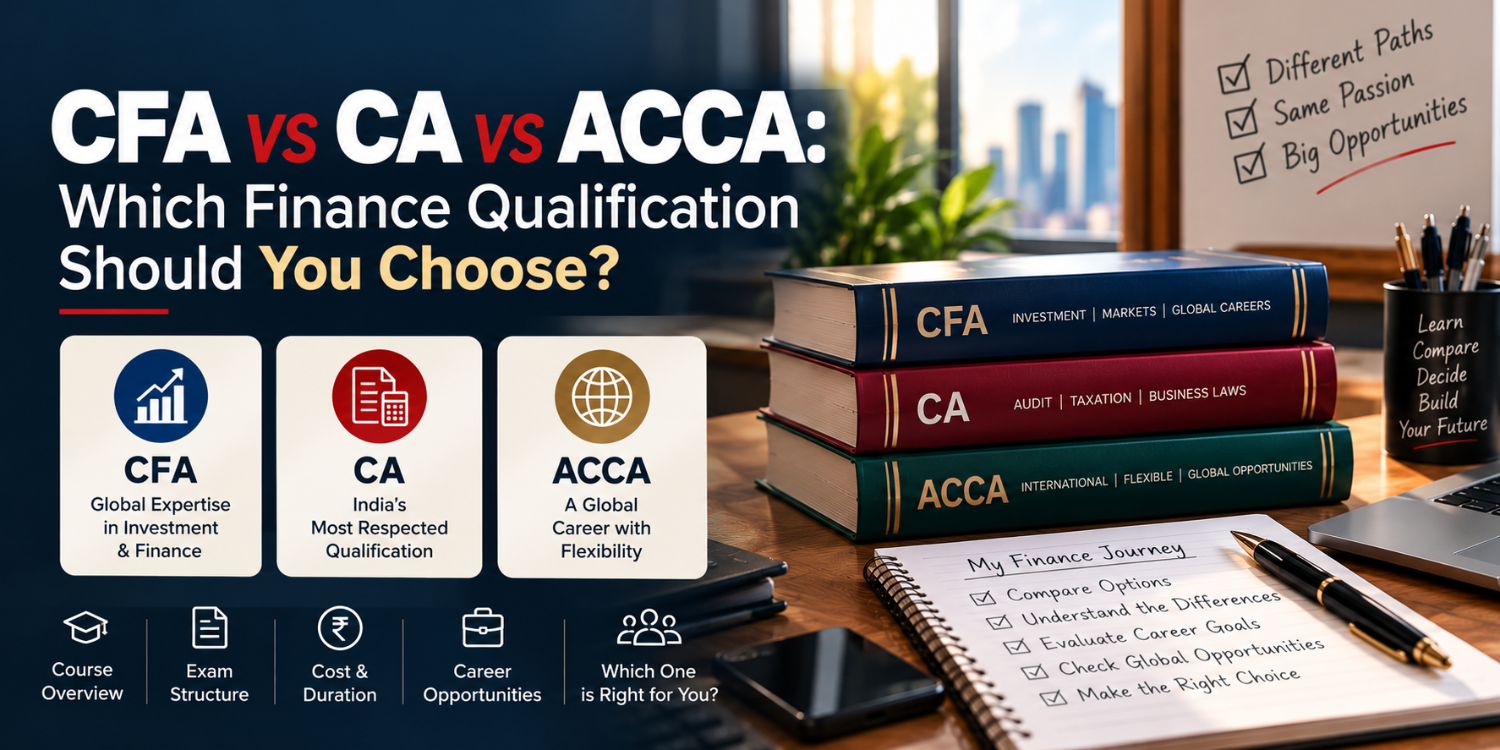
Which one is best?” is the wrong question. The right question is: which one fits the career you want in the next ten years? CFA vs CA vs ACCA, overlap in name recognition but differ sharply in focus, structure and where they open doors.
This guide compares them honestly, so you can choose with clarity rather than peer pressure.
The 30-Second Answer
- Choose CA if you want a career in Indian audit, taxation, compliance or finance leadership with strong domestic recognition.
- Choose ACCA if you want global accounting, audit, reporting or finance roles, with flexible exam sittings and recognition across many countries.
- Choose CFA if you want to work in investments: equity research, portfolio management, asset management or investment banking.
What Each Qualification Is
CA (Chartered Accountant)
ICAI conducts the CA course in India. The route includes Foundation, Intermediate and Final levels, plus practical training (articleship). CA holds statutory authority in India for roles such as statutory audit and certain certifications, which makes it central to Indian practice.
ACCA (Association of Chartered Certified Accountants)
ACCA is a global professional body. Its qualification currently has 13 exams, and from 2027 it moves to a restructured model of 11 exams. It also requires relevant practical experience for membership. You can read more in our guide to the ACCA 2027 changes.
CFA (Chartered Financial Analyst)
The CFA Institute offers the CFA programme in three levels. It focuses on investment analysis, ethics and portfolio management, and it requires relevant work experience before you can earn the charter. Level I is multiple-choice, and the later levels add case-based formats.
Side-by-Side Comparison
| Factor | CA | ACCA | CFA |
| Main focus | Audit, tax, law, accounting | Accounting, audit, reporting, management | Investments, valuation, portfolio management |
| Awarding body | ICAI (India) | ACCA (global) | CFA Institute (global) |
| Structure | Foundation, Intermediate, Final plus training | Three levels; moving from 13 to 11 exams in 2027 | Three levels |
| Exam style | Mostly written; some objective | Computer-based and written, depending on paper | Mostly MCQ, with case formats at later levels |
| Strongest recognition | India | Global, especially UK, Middle East, Africa, Asia | Global, especially investment industry |
| Typical roles | Auditor, tax consultant, CFO track | Financial controller, auditor, reporting analyst | Research analyst, portfolio manager, banker |
| Exemptions | Limited | Available for eligible graduates and some CA candidates | Not applicable |
Verify fees, eligibility and duration with each body, because they change often and vary by route.
Difficulty: How Do They Really Compare?
Each course is hard in a different way.
- CA: Heavy syllabus, written exams, long preparation and a demanding practical-training phase.
- ACCA: Many exams, but spread across sittings; consistency matters more than marathon study.
- CFA: A broad, deep curriculum tested through MCQs; CFA Institute suggests candidates plan around 300 hours of study per level.
None is “easy”. Therefore, choose the one whose difficulty matches your strengths. If you enjoy writing detailed answers and law, CA fits. If you prefer structured modules and flexibility, ACCA fits. If you enjoy markets and quantitative analysis, CFA fits.
Career Paths and Salary Reality
Salaries vary by city, employer, experience and skill, so ignore any blog that promises a fixed number. Instead, compare roles:
- CA: Statutory audit, tax advisory, GST and compliance, internal audit, CFO pipeline in Indian companies.
- ACCA: Multinational finance teams, Big Four audit, financial reporting, management accounting, overseas roles.
- CFA: Equity research, asset management, wealth management, risk and investment banking.
AI and automation are reshaping all three, and the strongest candidates pair their qualification with data skills. Our article on whether AI will replace accountants explains which skills to build.
Can You Combine Them?
Yes, and many professionals do. A CA with a CFA gains investment credentials; an ACCA member can add CFA for a markets pivot. However, avoid starting two heavy courses at once. Finish one, then add another if your career needs it.
Which Should You Choose? A Quick Decision Guide
Ask yourself:
- Where do I want to work? India-centred practice points to CA; global mobility points to ACCA or CFA.
- What work excites me? Audit and tax lean CA; reporting and finance leadership lean ACCA; markets lean CFA.
- How do I prefer to study? Large written syllabus suggests CA; modular suggests ACCA; MCQ-driven suggests CFA.
- What are my time and budget limits? Compare total cost and duration, not only the first exam.
Studying in Mumbai: What to Look For
Mumbai has strong coaching options for all three. Whichever you pick, evaluate faculty experience, batch size, test practice and placement or career guidance. EdgeX Learning offers CA classes in Mumbai, ACCA coaching in Mumbai and a CFA course in Mumbai, so you can discuss all three options with one counsellor rather than hearing a single-course pitch. If CFA appeals to you, read our 6-month CFA Level 1 study plan.
Frequently Asked Questions
Which is better, CFA, CA or ACCA?
None is universally better. CA suits Indian audit and tax, ACCA suits global accounting careers and CFA suits investment careers.
Is ACCA equal to CA?
They differ in scope and recognition. CA carries statutory authority in India, while ACCA offers broader international recognition.
Which is the toughest among CFA, CA and ACCA?
Each is demanding in its own way. CA is the longest and most written-exam intensive; CFA is broad and MCQ-heavy; ACCA tests consistency across many papers.
Can I do CFA after CA or ACCA?
Yes. Many professionals add CFA to move into investment roles.
Which is best after 12th commerce?
CA Foundation, ACCA and CFA (after graduation or in the final year of a degree, per CFA Institute rules) are all possible. Choose based on career goals, then check our commerce programmes for foundation support.
Which finance course has the best scope in 2027?
All three offer scope. Employers now reward professionals who combine qualifications with technology and data skills.