
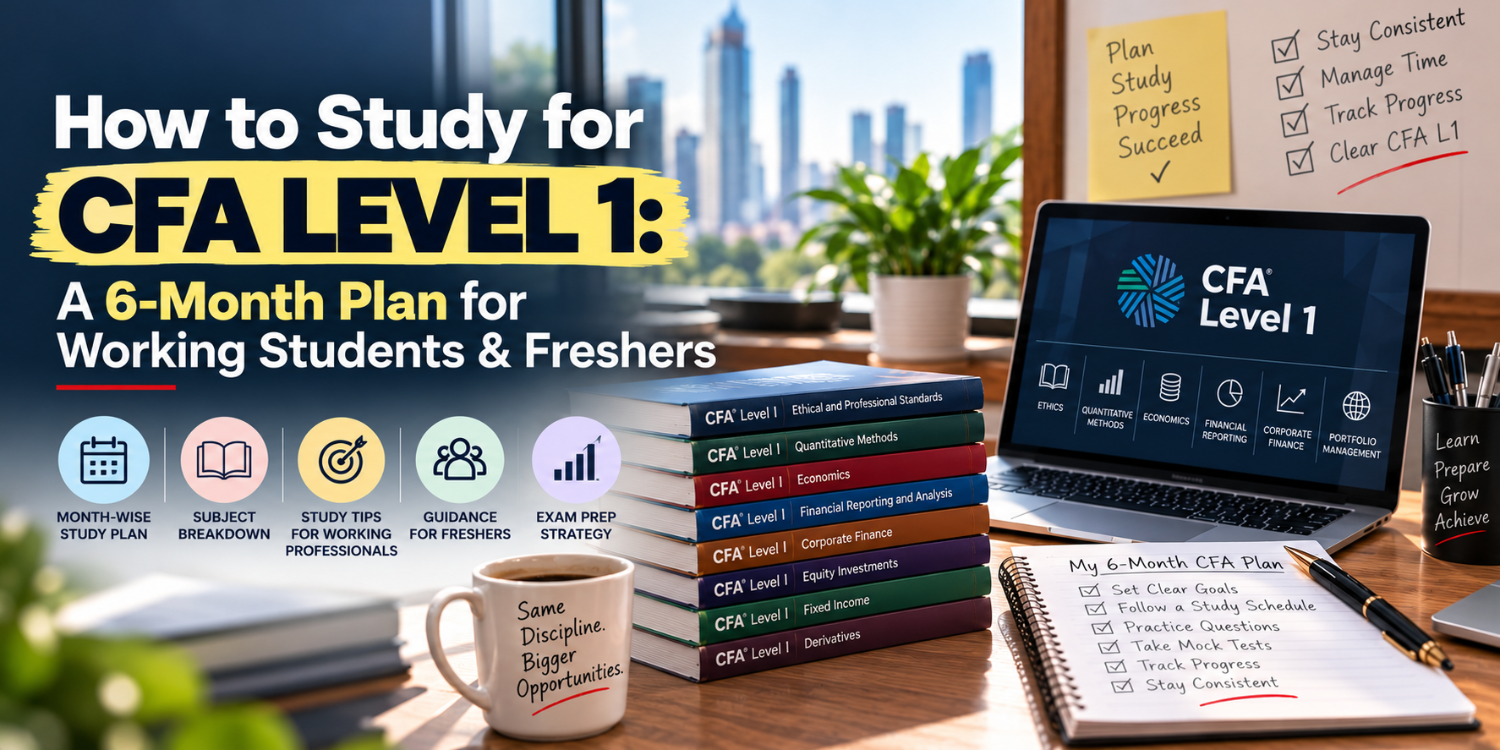
The CFA Institute suggests candidates plan for roughly 300 hours of study per level. That number scares people until they divide it: 300 hours across 26 weeks is about 11–12 hours a week. That is two focused hours on weekdays and a solid weekend block. This plan shows you how to spend those hours wisely.
Know the Exam Before You Plan
Level I is a multiple-choice exam. Recent formats use 180 questions across two sessions. Because CFA Institute updates formats, windows and eligibility rules, confirm the current details on its website before you register.
The curriculum covers ten topic areas:
- Ethical and Professional Standards
- Quantitative Methods
- Economics
- Financial Statement Analysis
- Corporate Issuers
- Equity Investments
- Fixed Income
- Derivatives
- Alternative Investments
- Portfolio Management
Topics carry different weights. Ethics, Financial Statement Analysis, Equity and Fixed Income typically carry the largest shares, so give them proportionally more time. Check the latest weightings on the CFA Institute site.
Who This Plan Is For
- Freshers and final-year students who can study 12–15 hours a week
- Working professionals who can study about 10–12 hours a week, with extra time in the final month
The plan assumes zero finance background. If you already hold a commerce degree, you may move faster through Accounting and Economics.
The 26-Week Plan
| Weeks | Focus | Goal |
| 1 | Orientation, exam format, study setup | Fix your schedule; choose resources |
| 2–3 | Quantitative Methods | Build the maths foundation |
| 4–5 | Economics | Understand macro and micro basics |
| 6–9 | Financial Statement Analysis | Master statements and ratios |
| 10–11 | Corporate Issuers | Capital structure, governance |
| 12–15 | Equity Investments and Alternative Investments | Valuation basics and asset classes |
| 16–19 | Fixed Income and Derivatives | Bond maths and pricing concepts |
| 20–21 | Portfolio Management | Risk, return, portfolio theory |
| 22–23 | Ethics (deep revision) | Standards and case application |
| 24–25 | Full-length mock exams | Timing and weak-area diagnosis |
| 26 | Light revision, rest | Confidence, logistics |
Start Ethics early with short weekly reviews, then return to it intensively. The topic rewards repetition.
A Weekly Rhythm for Working Students
- Monday to Thursday: 1.5–2 hours each evening. Read one chapter section and solve questions on it.
- Friday: Rest or a 30-minute flashcard review.
- Saturday: 4–5 hours. Complete the week’s remaining reading and a timed question set.
- Sunday: 2–3 hours. Review mistakes and update your formula sheet.
Block your calendar like a meeting, because “whenever I find time” usually means never.
The Study Method That Works
Use a three-step loop for every topic:
- Learn: Read or watch the lesson once with full attention.
- Apply: Solve practice questions immediately.
- Review: Log every wrong answer and write why you missed it.
Question practice matters more than re-reading. In our experience supporting candidates, those who solve questions from week 2 onwards retain far more than those who read first and practise later.
Calculator and Formula Skills
CFA allows approved calculators only, so learn yours early. Practise time value of money, statistics and bond functions until they are automatic. Keep a one-page formula sheet for each topic and revise it every Sunday.
Mock Exams: Your Final Eight Weeks
From roughly week 18, start mixing mixed-topic question sets. In weeks 24–25, attempt at least three to four full mock exams under real timing. After each one:
- review every wrong answer and every lucky guess,
- tag mistakes as concept, calculation or reading errors, and
- revisit weak topics within 48 hours.
Online vs Classroom: How to Choose
Both formats work, so match the format to your life.
| Factor | Online course | Classroom coaching |
| Flexibility | High | Fixed schedule |
| Accountability | Self-driven | Built-in |
| Doubt solving | Depends on provider | Often immediate |
| Best for | Busy professionals, other cities | Freshers who want structure |
When you compare a CFA Level 1 online course or CFA online coaching, ask about live doubt sessions, recorded access, mock exam analysis and faculty credentials. For Mumbai students who prefer in-person discipline, EdgeX Learning runs a CFA course in Mumbai with structured classes, mock exams, a practice question bank and regular doubt-solving sessions. You can also explore our CFA classes in Mumbai page for course details.
Common Mistakes to Avoid
- Ignoring Ethics until the end. Study it throughout.
- Reading without practising. Questions reveal what you actually know.
- Skipping mocks. They train stamina and timing.
- Burning out in month two. Consistency beats intensity.
- Choosing a date before you check readiness. Pick your exam window, then confirm that your mock scores support it.
Is CFA the Right Choice for You?
CFA suits careers in investment research, portfolio management and markets. If you are still weighing options against CA or ACCA, our CFA vs CA vs ACCA guide will help. Because the field is changing fast, also read our article on whether AI will replace accountants to see which complementary skills matter.
Frequently Asked Questions
How many hours do I need to study for CFA Level 1?
CFA Institute suggests planning around 300 hours. Many candidates spend more if they are new to finance.
Can I study for CFA Level 1 while working full-time?
Yes. Plan 10–12 hours a week for about six months, and protect your weekend blocks.
Is six months enough for CFA Level 1?
For most disciplined candidates, yes. Freshers without finance exposure may want seven or eight months.
What is the CFA Level 1 passing score?
CFA Institute does not publish a fixed passing percentage; it sets a minimum passing score for each exam. Aim to score comfortably above 70% in your mock exams as a safety margin.
Which topic should I study first?
Start with Quantitative Methods and Economics, because they underpin later topics, and revisit Ethics weekly.
Is a CFA online course enough, or do I need classroom coaching?
Either can work. Choose the format that gives you the accountability and doubt support you need.
Who is eligible to register for CFA Level 1?
Candidates generally need to hold, or be in the final year of, a bachelor’s degree, or have relevant professional experience. Confirm current rules with CFA Institute.